The first time I helped support a control server recovery at a packaging facility, someone asked "How long will this take?" We did not have a good answer. The backup existed.
The process to restore it safely in a live production environment did not. We had carried IT assumptions into an OT problem, and it cost the plant an entire shift.
IT/OT convergence created a gap that most backup vendors were not built to close. Production systems need continuous uptime. Recovery has to happen fast, without deep IT expertise on-site, and without disturbing active processes while it runs.
Most enterprise backup tools were designed for office infrastructure and adapted for industrial use after the fact. In OT, that mismatch shows up during incidents, not during evaluations.
According to NIST SP 800-82 Rev. 3, OT environments prioritize availability and integrity over confidentiality because physical processes depend on continuous, predictable operation.
Per IEC 62443, industrial cybersecurity is structured around zones, conduits, and risk reduction for live operations.
If you’re looking for a cyber resilience platform built for OT and ICS environments, not a generic IT backup tool retrofitted for industrial use, you need something designed around MTTR (mean time to recover) as the defining KPI.
Acronis Cyber Protect for OT addresses each of these requirements directly.
Acronis Cyber Protect for OT is a cyber resilience platform designed specifically for industrial control system environments, prioritizing operator-led recovery, legacy OS support, and MTTR reduction over conventional IT backup approaches.
Plants run 24/7. Maintenance windows are short, often measured in minutes rather than hours, and rescheduling them has real production costs.
Deterministic control systems do not tolerate the background I/O load that enterprise backup agents were designed to run. Many assets sit in Purdue Level 2–3 segments with strict network boundaries, and a significant share operate fully air gapped.
OT teams are also structured differently from IT. Onsite staff tend to be operators and reliability engineers, not system administrators.
When something fails at 2 a.m., whoever is on site needs to restore service without escalating to a remote IT chain. Fast, operator executable recovery is not a preference: it is an operational requirement.
According to NIST SP 800-82 Rev. 3, OT systems face distinct constraints, including limited downtime tolerance, long infrastructure lifecycles, and restricted connectivity (NIST SP 800-82 Rev. 3). Software that was not built for those constraints creates new failure modes when it is dropped into them.
For that reason, OT teams are better served by a platform designed specifically for real-time environments, which is where Acronis OT positions itself.
Legacy Windows & Linux support (the “unpatchable” reality)
Brownfield plants, meaning existing facilities built around legacy systems rather than new “greenfield” environments, often keep assets running for 15 to 30 years.
According to NIST SP 800-82 Rev. 3, many OT component lifetimes run 10 to 15 years, with full system lifespans exceeding 20.
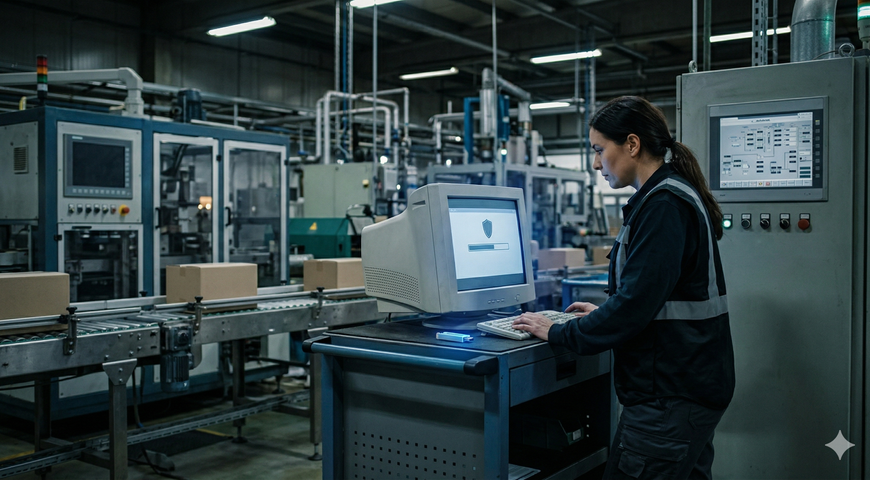
Those numbers have a direct consequence: Windows XP, Server 2003, Vista, and Windows 7 are still active in isolated production zones at facilities that have never had a reason to replace them.
OS upgrades in OT are not straightforward IT migrations. A major OS change on a control workstation can void OEM qualifications, trigger recertification requirements, or break vendor support agreements.
The business case for upgrading rarely clears that bar, especially on assets that are running fine.
In that context, backup and recovery become the primary cyber resilience control that does not create certification risk.
Acronis explicitly covers Windows XP, Server 2003, Vista, and Windows 7, plus Linux kernels from 2.6.9 to 5.19. Legacy systems are treated as first-class citizens, not edge cases (securing OT environments after Windows end of support).
The right IT resource is rarely standing next to the failed machine. Shift operators and reliability engineers are. We have seen recovery timelines stretch to full shifts not because the backup was bad but because the restoration process required skills that were not on site at the time of the failure.
Operator-led recovery removes that dependency. Acronis OT supports one-click recovery workflows, local secure zones, and bootable recovery paths that operators can execute without IT involvement.
When a legacy controller workstation fails, identical replacement hardware is often unavailable. Model lines are discontinued, lead times are long, and urgent procurement means sourcing whatever is closest. A backup is only useful if it boots on the hardware you actually have.
Universal Restore handles P2P, P2V, and V2P recovery and injects the required HAL and storage drivers during bare-metal restore (BMR) when hardware differs from the source.
Practically, this means workload function is restored first and hardware alignment is resolved later, without chasing obsolete spare parts on a tight production timeline.
Signature-based AV has a specific weakness in OT: signatures need regular updates, and air-gapped or semi-isolated environments cannot always receive them.
Strict change controls further limit how often signatures can be refreshed, which leaves windows where newer payloads go undetected.
Behavioral detection does not share that dependency. Acronis Active Protection monitors for ransomware-type behavior without requiring cloud connectivity, and it extends protection to both production data and backup files, including malware scanning in restore workflows.
On HMIs and operator workstations, performance impact is a hard constraint.
Security controls that introduce latency or interfere with control responsiveness are not acceptable in those environments. Policy tuning by asset role keeps protection active without disrupting process visibility.
Immutable backups & backup-before-patch
Attackers who target OT environments know backup repositories are the recovery path. Corrupting or encrypting backups removes the restoration option and increases leverage. Immutable storage closes that vector.
Once written, backup data cannot be altered or deleted within the retention window regardless of how the management layer is compromised.
Acronis immutable storage uses WORM (write once, read many) behavior with two lock modes: governance mode allows controlled administrative operations under policy, while compliance mode enforces stricter retention controls without administrative override.
For patching legacy systems, the recommended pattern is backup-before-patch: take a clean backup before applying updates, and roll back immediately if the patch causes instability. Acronis OT supports this workflow directly.
On systems where a failed patch can halt production or break vendor certification, fast rollback is not optional.
Deployment requirements vary by facility. Fully air-gapped, on-prem-only operation is a hard requirement at some sites.
Others accept hybrid management, with cloud-based policy and monitoring paired with local backup storage, as long as recovery data stays within the site boundary. Both are valid.
The more important design question is whether the platform respects OT network boundaries rather than assuming enterprise-style connectivity.
In environments aligned with Purdue Model principles, unsolicited communication from higher enterprise or cloud layers into lower OT levels is minimized or restricted.
Acronis fits that model by relying on OT-side endpoints to initiate outbound, client-driven connections for policy checks, status reporting, and approved updates, rather than requiring inbound connections into lower-level OT systems.
That makes it compatible with segmented architectures where cloud-managed does not mean cloud-dependent or intrusive to Level 0/1 operations.
In OT procurement, OEM validation carries more weight than feature comparisons. A backup solution that is tested and documented against a specific control system is more credible to plant teams than generic capability claims.
Honeywell documents Experion Backup & Restore as an operational backup and restore layer for Experion PKS environments, including recovery to dissimilar hardware and virtual targets.
And Emerson documents DeltaV Backup and Recovery for its automation stack.
Acronis holds Rockwell Automation Encompass Partner status and documents OEM ecosystem alignment with major industrial vendors.
You’ll want to confirm exact integration scope and support boundaries against current vendor documentation for your specific control system versions.
Coexisting with OT security & monitoring tools
Detection and recovery serve different purposes and should not be confused. Dragos, Claroty, and Nozomi are established tools for OT asset visibility, threat detection, and exposure management. They are good at identifying threats and prioritizing responses.
But detection does not restore a failed HMI, historian, or engineering workstation. When an incident affects production systems, visibility data tells you what happened. It does not bring the line back up. Recovery has to close that loop.
The stack boundary is clean: monitoring platforms handle, detect, and prioritize; Acronis handles protect and recover. Keeping those roles separate reduces overlap and makes response execution clearer when an incident is running.
A legacy HMI server fails mid-shift at a packaging plant running high-margin orders. The line is down. The shipment window is closing. This is not a hypothetical.
It is a version of the same incident we see repeated across brownfield facilities. According to ABB global research (ABB, 2023), average manufacturing downtime costs around $125,000 per hour, and an eight-hour outage can exceed $1 million.
In a standard IT-style response, the team searches for matching replacement hardware, escalates to a remote IT resource, and rebuilds manually. MTTR extends to a full shift or longer. We have sat in the post-mortems. The backup was fine. The process around it was not.
In an OT-ready model, the operator initiates a one-click recovery workflow. The latest clean image restores from immutable storage onto available hardware using Universal Restore. Production resumes in minutes.
The difference between those two outcomes is why MTTR is the defining OT resilience KPI, not data recovery percentage or backup completion rate.
Acronis Cyber Protect for OT is designed to deliver the second outcome in brownfield environments with legacy systems, constrained connectivity, and operators doing the recovery work.
Frequently asked questions
What is Acronis Cyber Protect for OT?
Acronis Cyber Protect for OT is a cyber resilience platform built specifically for operational technology environments, including ICS, SCADA servers, HMIs, engineering workstations, and production historians. Unlike generic IT backup tools adapted for industrial use, it is designed around MTTR as the primary recovery KPI, with operator-executable workflows, offline behavioral protection, and legacy OS support as first-class capabilities. It supports fully air-gapped, on-premises, and hybrid deployment models to match the network constraints of brownfield facilities. The platform integrates backup, immutable storage, behavioral detection, and dissimilar hardware recovery into a single solution sized for production environments rather than enterprise IT.
Does Acronis support Windows XP and legacy industrial operating systems?
Yes. Acronis Cyber Protect for OT explicitly covers Windows XP, Server 2003, Vista, and Windows 7, as well as Linux kernels from 2.6.9 to 5.19. Legacy OS support is a deliberate design requirement, not an edge case, because brownfield OT assets commonly run for 15 to 30 years on configurations that cannot be upgraded without voiding OEM qualifications or triggering recertification. For these systems, backup and recovery is the primary resilience control that does not introduce certification risk. Treating legacy operating systems as supported platforms allows plant teams to maintain protection coverage across the full asset lifecycle.
What is one-click recovery in OT environments?
One-click recovery is a simplified restore workflow that allows a local operator or reliability engineer to initiate a full system recovery without IT involvement. In OT settings, recovery often fails not because the backup is missing but because the restoration process requires skills that are not on site during a shift. One-click recovery removes that dependency by storing a bootable recovery path and a clean system image locally, accessible through a simple interface. The operator initiates recovery, and the system restores from the latest clean image without requiring remote escalation, specialist access, or manual rebuild steps.
What is Universal Restore and why does it matter for OT?
Universal Restore enables recovery of a system image onto hardware that differs from the source machine, handling P2P, P2V, and V2P scenarios by injecting the correct HAL and storage drivers during the restore process. In OT, this capability is critical because legacy controller workstations and HMIs are often on discontinued hardware lines with long procurement lead times. When a failure occurs under production pressure, the available replacement hardware may not match the original configuration. Universal Restore allows the workload to be restored to whatever hardware is available, restoring production function immediately while hardware alignment is resolved separately.
How does Acronis Cyber Protect for OT handle air-gapped environments?
Acronis Cyber Protect for OT supports fully air-gapped deployment, storing backup data locally in secure zones without requiring connectivity to external infrastructure. Active Protection’s behavioral detection engine operates offline, monitoring for ransomware-type activity based on behavioral patterns rather than signature updates, which eliminates the signature currency problem common in isolated environments. Where hybrid management is used, the platform uses a client-initiated, outbound connection model: OT-side endpoints initiate communication for policy checks and approved updates rather than accepting inbound connections from higher network layers. This approach is compatible with Purdue Model segmentation and keeps cloud management from becoming a network intrusion point into lower OT levels.
Conclusion
In OT, resilience is not about whether the backup finished. It is about whether you can recover fast without creating more risk for production.
That is why OT-ready cyber resilience needs to support legacy systems, constrained environments, and operator-led recovery.
Acronis Cyber Protect for OT is built for that reality. (And for manufacturing-specific resilience planning, you can check out Acronis Cyber Protect designed specifically for manufacturing.

About Acronis
A Swiss company founded in Singapore in 2003, Acronis has 15 offices worldwide and employees in 60+ countries. Acronis Cyber Platform is available in 26 languages in 150 countries and is used by over 21,000 service providers to protect over 750,000 businesses.